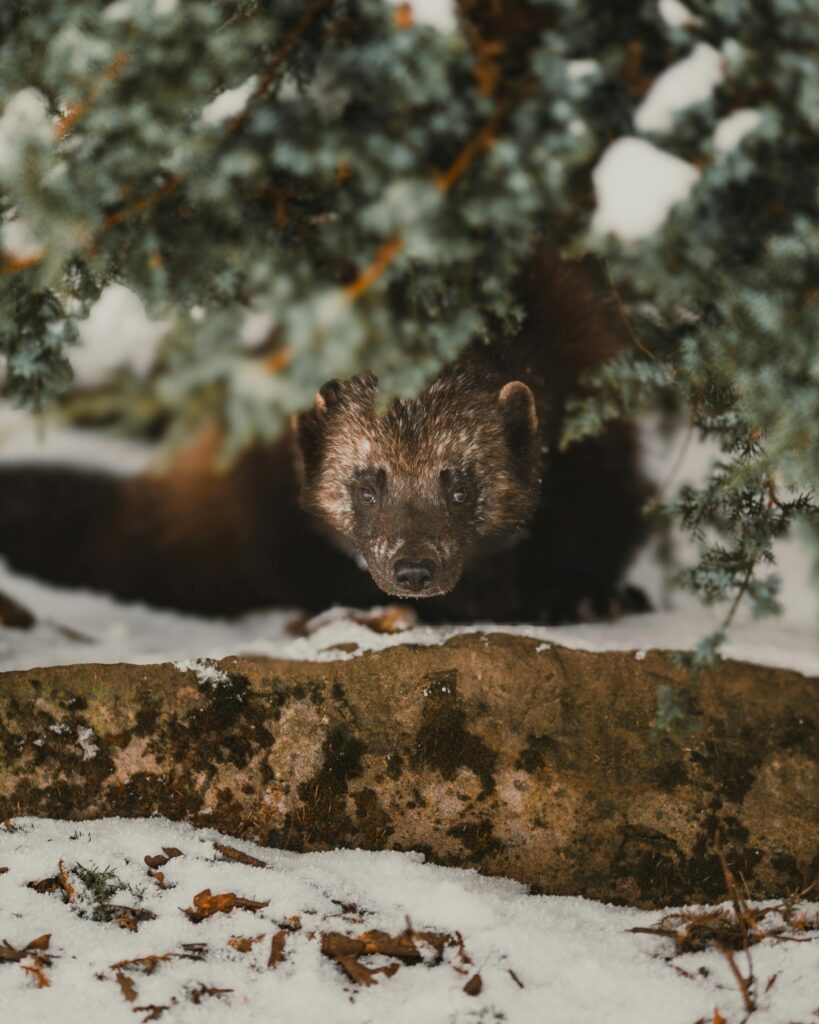
Conservation Status
North America
The following is an abridged version of the information found on the website of The Wolverine Foundation, a non-profit organization comprised of wildlife scientists with a common interest in the wolverine. You can see the entirety of this information, including related citations, here on their website.
Canada (Excerpted from: Slough 2007)
Following COSEWIC’s (Committee on the Status of Endangered Wildlife in Canada) first assessment of the status of the wolverine in Canada, it delineated two geographically separated wolverine populations in 1989, the eastern population of Quebec and Labrador and the western population of northern Ontario, Manitoba, Saskatchewan, Alberta, British Columbia, Northwest Territories, Nunavut and Yukon (Dauphiné 1989). The eastern population was isolated from the western population by the 1960s (Dawson 2000), and densities have since declined to very low levels or possible extirpation (Fortin et al. 2005). Likewise, there has been no evidence of wolverines on Vancouver Island since 1992 where the population and/or subspecies may be extirpated (E. Lofroth, pers. comm.). Two subspecies of wolverines are recognized in Canada (Hall 1981); G. g. luscus, found across Canada, and G. g. vancouverensis, found on Vancouver Island. Banci (1982) found little evidence for classifying the Vancouver Island population as a distinct subspecies, however it is still recognized as such (Nagorsen 1990).
The present range of wolverines in Canada includes much of northern and western Canada, where they inhabit a variety of treed and treeless ecological areas at all elevations. Range reductions began with human settlement in the mid-19th century in New Brunswick (where wolverines were extirpated), boreal Ontario, Quebec and Labrador, and in the aspen parklands of Manitoba, Saskatchewan and Alberta. Wolverines never occurred in Newfoundland, Nova Scotia, Prince Edward Island, the Queen Charlotte Islands, and some islands of the Northwestern Arctic Archipelago in the Northwest Territories and Nunavut (Dauphiné 1989). The northward range shift in Ontario may have been influenced by climatic warming since the 1800s, which has led to a decrease in snow cover needed for successful denning (Aubry et al. 2007). It is doubtful whether viable populations ever occurred in southern Ontario, the prairies, or the arid region of southern British Columbia, since historical depictions of wolverine range (e.g. Kelsall 1981) were largely compiled from unverifiable anecdotal evidence, extralimital records, and the interpretation of fur returns, which were tied to socio-economic factors and not necessarily furbearer populations at the source of data collection. In any case, these areas did not produce consistent long-term wolverine harvests (Novak et al. 1987).
United States (except Alaska) (Excerpted from: Aubrey et al. 2007)
The distribution of current wolverine records in the contiguous United States is limited to north-central Washington, northern and central Idaho, western Montana, northwestern Wyoming, and Oregon.
Contrary to most previous interpretations (Seton 1929, Hall 1981, Hash 1987), the wolverine’s historical range was discontinuous in the Pacific states. A similar pattern was noted in the Rocky Mountains; wolverine distribution appears to have been relatively continuous in Idaho, Montana, and Wyoming, but there are substantial gaps in our records in southwestern Wyoming and northwestern Colorado that correspond to gaps in the distribution of both alpine habitat conditions and spring snow cover. …. Wolverine populations in Colorado and Utah may also have been isolated to some degree, and genetic tests of this hypothesis are in progress (M. K. Schwartz, United States Forest Service, personal communication). Causal factors for the apparent extirpation of wolverine populations in the Sierra Nevada and southern Rocky Mountains by the mid-1920s are unknown.
Published accounts by early naturalists indicate that wolverines were rarely, if ever, encountered in the upper Midwest and Northeast regions of the contiguous United States. Historical records are sparse and haphazard in that area, and the habitat conditions that are associated with wolverine records in the western United States are generally lacking. Additionally, some early wolverine records from the northeastern United States may represent misidentifications. Most wolverine records from that region cannot be verified and, according to several historical accounts from the 1800s, both bobcats (Lynx rufus) and Canada lynx (Lynx canadensis) were sometimes called wolverines by early settlers (Penobscot 1879, Hough 1893). Thus, available evidence suggests that wolverine records from the northeastern United States probably represent dispersals from populations in other regions. Whether wolverines occurred in that region prior to European settlement is unknown. Range loss was most apparent in the southern and eastern portions of their historical distribution in California, Utah, Colorado, and the Great Lakes region.
The wolverine may have experienced significant population declines or local extirpations in the Cascade Range and northern Rocky Mountains during the early 1900s, as has been speculated (Wright and Thompson 1935, Newby and Wright 1955, Newby and McDougal 1964). Between 1921 and 1950, there is only 1 wolverine record from Washington, 1 from Oregon, 5 from Idaho, 13 from Montana, and 1 from Wyoming. However, records from these states in subsequent years were relatively numerous, suggesting that wolverine populations may have become reestablished in northwestern regions after a period of range-wide decline.
During the 1960s and 1970s, wolverines began appearing in low-elevation, nonforested habitats in eastern Washington and Oregon. Several authors claimed that these and other verifiable records obtained during this period demonstrated that wolverines were reclaiming broad expanses of their former range (e.g., Nowak 1973, Yocom 1974, Johnson 1977). In 2011, wolverines were documented in northeast Oregon; …. however, there is still no evidence of wolverine occurrence in eastern Washington currently. It is unclear why wolverines began appearing in previously unoccupied areas during this time period. Previous researchers speculated that wolverine populations became reestablished in Montana during the mid-1900s through dispersals from Canada (Newby and Wright 1955) and subsequently expanded their numbers and distribution in the northern Rocky Mountains (Newby and McDougal 1964). Thus, anomalous wolverine records in eastern Washington and Oregon during that time probably represent dispersals from Canada or Montana that failed to establish resident populations.
Alaska
Alaska appears to support viable populations of wolverines throughout the state, with the exception of islands in the Bering Sea, the Aleutian chain, Kodiak, Prince William Sound, and outer islands in the Alexander Archipelago (Copeland and Whitman, 2003). No statewide population estimates are available.
tside the core Arctic/boreal range, wolverines have been extirpated from parts of Asia