
North America Ecology / Distribution
“Although game managers can’t say how many wolverines inhabit Montana, a realistic estimate would be 100 to 150, tops. Idaho might support a similar number, primarily in its wilderness areas. The ecosystem that includes Yellowstone and Grand Teton National Parks could have another 50 animals. Washington’s North Cascades ecosystem hosts a handful. And that’s pretty much it for Lower 48 gulos.”
NORTH AMERICA
Canada
Wolverines are relatively widespread across northern and western Canada, including in boreal forest, mountain, and arctic tundra ecosystems. Canadian population estimates suggest there are likely more than 10,000 adult wolverines nationwide, potentially in the 15,000–20,000 range, based on extrapolations from density and range data.
Most of these animals live in the northern regions of these provinces: Yukon, Northwest Territories, Nunavut, British Columbia, Alberta, Saskatchewan and Manitoba. While once present in much of southern and eastern Canada, wolverines have been extirpated from New Brunswick, southern Ontario, and the southern parts of the Prairie Provinces. Populations in Quebec and Labrador have declined to very low levels or possibly been extirpated.
Preferring large expanses of wilderness and exhibiting remarkable ecological flexibility, wolverines in Canada typically live in the boreal forests, alpine tundra and subalpine regions, Arctic tundra, and northern mountainous terrain. In terms of their diet, carrion from large ungulates — particularly moose, caribou, muskox, and animals killed by wolves or avalanches — is very important, especially in winter. A wolverine’s prey in summer also includes marmots, snowshoe hares, rodents, and ground-nesting birds.
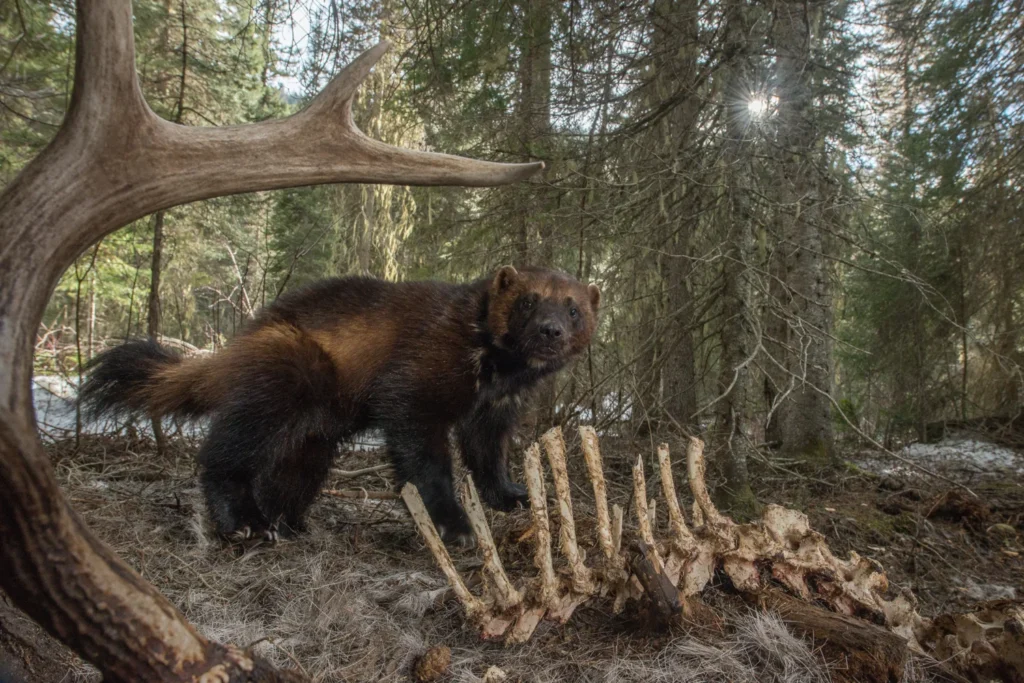
Alaska
Alaska has wolverines across much of the state at low natural densities, but no statewide population estimates are available. Based on density studies, there are four-to-five wolverines per 1,000 km² (390 mi²) in south-central Alaska and somewhat higher numbers in some northern regions of the state. Alaska’s population is far larger and much less imperiled than in the Lower 48 states.
Wolverines are found throughout mainland Alaska — including boreal forests, mountains, and tundra zones — apart from islands in the Bering Sea, the Aleutian chain, Kodiak, Prince William Sound, and outer islands in the Alexander Archipelago. Like elsewhere across its global range, wolverines use a variety of alpine, tundra and boreal forest habitats, all tied to extensive wilderness areas with minimal human disturbance.
And like wolverines elsewhere, for their diet they depend heavily on carcasses of moose, caribou, deer, and other large mammals left by predators or winter kill. They can also occasionally kill young or weakened ungulates and are well adapted to crushing frozen meat and bones. Finally, in the summer months, wolverines in Alaska also feed on rodents, hares, marmots, birds, eggs, and insects.
Contiguous U.S. (Lower 48)
The best guesstimate for the number of wolverines in the Lower 48 states is somewhere around 300 individuals, almost exclusively living in the mountain ranges of the Northern Rocky Mountains (Montana, Idaho and Wyoming) and Pacific Northwest (Cascade Range of Washington and Oregon). Studies focused on wolverine movement and genetics in the contiguous U.S. confirm that these populations are connected to Canadian populations, which is important for the long-term viability of the U.S. sub-populations. Either way, wolverine numbers in the U.S. remain low and vulnerable. What populations existed historically east of the Rocky Mountains were long-ago extirpated. In terms of the wolverine’s diet in the Lower 48 states, it is the same as explained above in Canada and Alaska.