
GENERAL ECOLOGY
“Then I started following wolverines around. They are smaller than I. Their lifespan is considerably shorter. Yet, whatever they do, they do undaunted. They live life as fiercely and relentlessly as it has ever been lived. If wolverines have a strategy, it’s this: go hard and high and steep and never back down, not even from the biggest grizzly and least of all from a mountain. Climb everything—trees, cliffs, avalanche chutes, summits. Eat everybody—alive, dead, long dead, moose, mouse, fox, frog, its still warm heart or frozen bones.”
The Wolverine’s Natural History and Ecological Role
in Alpine and Boreal Ecosystems
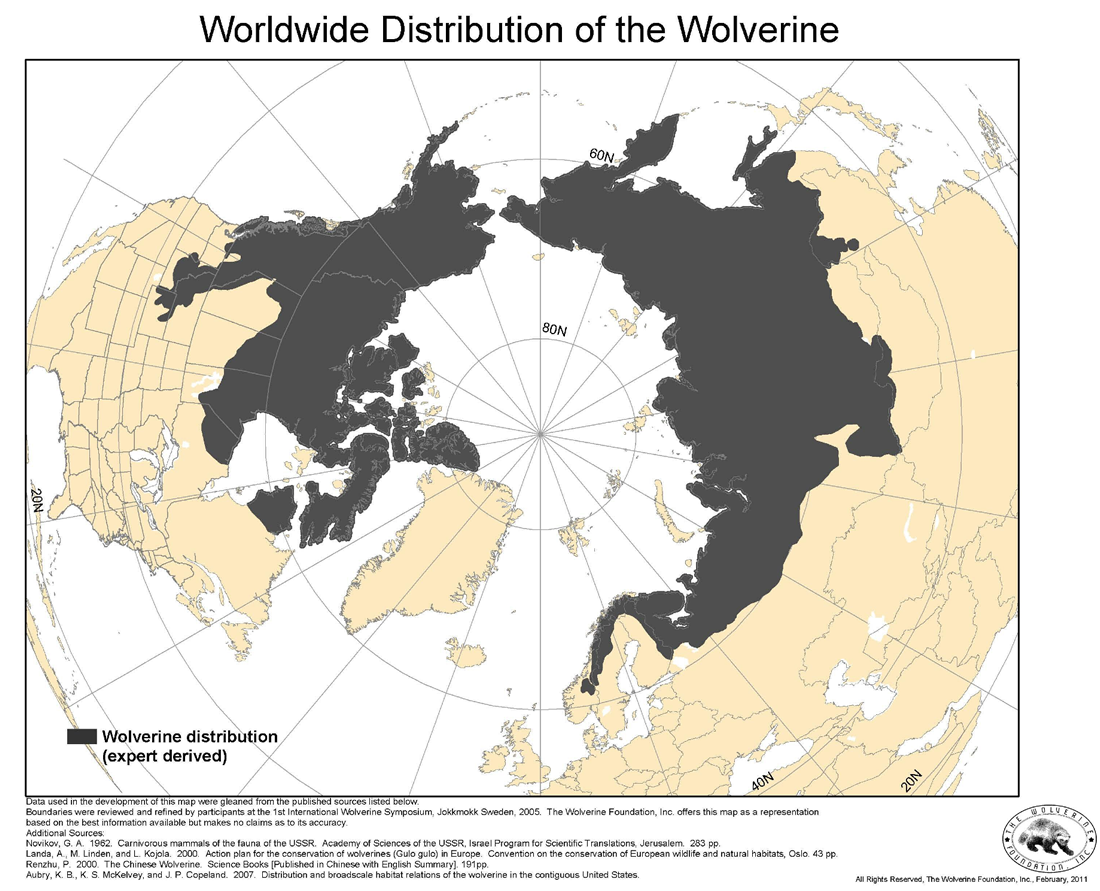
The wolverine (Gulo gulo) is a circumpolar, northern-hemisphere, cold-adapted carnivore whose ecological influence in alpine and boreal ecosystems far exceeds its relatively low abundance (world distribution map at the right from The Wolverine Foundation). Wolverines are naturally sparse and live at very low densities across northern North America and Eurasia (the global population of wolverines is estimated at 15,000–30,000 individuals, mostly in Russia and Canada). They require persistent spring snowpack for denning and reproduction, making them particularly sensitive to climate change. They occupy some of the planet’s harshest landscapes—high-elevation alpine tundra and vast boreal forests characterized by long winters, deep snow, and seasonal pulses of food availability. Within these environments, their ecological role can be understood through the six interconnected functions below.
Mid-Level Predator
As a mid-level predator, the wolverine occupies a trophic position below apex predators such as wolves and bears but above smaller carnivores like foxes and martens. In alpine habitats, wolverines prey on marmots, pikas, ground squirrels, ptarmigan, and occasionally weakened ungulates. In boreal forests, they hunt snowshoe hares, grouse, and small mammals. Though capable hunters, they are opportunistic and adjust their foraging strategies to seasonal conditions. Their predation helps regulate populations of small and medium-sized prey, contributing to trophic balance in ecosystems where energy flow is strongly seasonal.
Specialized Winter Scavenger
Perhaps the wolverine’s most defining ecological function is as a specialized winter scavenger. Alpine and boreal systems experience significant ungulate mortality during winter, creating carcasses that may become buried beneath snow. Wolverines possess powerful jaws capable of crushing frozen bone and an acute sense of smell that allows them to detect carrion beneath deep snow. Their large, snow-adapted feet enable efficient winter travel across rugged terrain. By locating, excavating, and consuming carcasses when few other scavengers can, wolverines fill a critical ecological niche during the leanest months of the year.
Nutrient Redistributor
In feeding and caching behavior, wolverines act as nutrient redistributors. They frequently transport pieces of carcasses across considerable distances and cache surplus food in snowbanks or cold microhabitats, effectively using snow as natural refrigeration. This movement spreads nutrients from large ungulate carcass sites into surrounding alpine tundra or boreal forest soils. Over time, these dispersed remains support microbial communities, invertebrates, and plant growth, subtly influencing nutrient cycling in otherwise nutrient-limited cold ecosystems.
Facilitator of Scavenger Guilds
Wolverines also facilitate broader scavenger guilds. After feeding on carcasses, they leave remains accessible to ravens, foxes, martens, and other scavengers. In late winter, when food scarcity peaks, these leftovers can sustain multiple species. In this way, the wolverine functions not merely as a consumer but as a provider within a network of carrion-dependent organisms. Their role is especially pronounced in remote alpine areas where alternative large scavengers may be absent during winter months.
Potential Keystone Species
Despite occurring at low densities and maintaining vast home ranges, wolverines may function as potential keystone species in snow-dominated systems. Their disproportionate influence on carrion dynamics, nutrient flow, and scavenger access means that their removal could alter winter food webs. In ecosystems where few species can exploit frozen carrion efficiently, the wolverine’s ecological role becomes magnified.
Indicator of Intact, Snow-Driven Ecosystems
Finally, the wolverine serves as an indicator of intact, snow-driven ecosystems. Reproductive females depend on persistent spring snowpack for denning, typically in alpine cirques or boreal snowdrifts. Their strong association with cold, low-human-density landscapes makes them a barometer of ecological integrity and climate stability. Declines in snow cover or habitat connectivity can directly affect their survival and reproduction, signaling broader environmental change.
Together, these six functions illustrate how the wolverine is not merely a resilient northern carnivore, but a central ecological actor in alpine and boreal ecosystems—shaping food webs, redistributing nutrients, and embodying the dynamics of winter itself.